
Abstract
Clinically meaningful functional improvement in advanced secondary progressive multiple sclerosis (SPMS) is uncommon. A 34-year-old man with very early-onset multiple sclerosis, currently classified as SPMS, completed a device-free, non-pharmacological SONAPS program (19 sessions over approximately 120-150 days). At baseline, the patient was fully wheelchair-dependent and exhibited severe multidomain impairment. Composite disability assessed using the Composite Disability and Functional Status Scale improved from 38/50 to 15/50. Improvements were observed across physical, functional, and psychological domains and were accompanied by gains in muscle strength (upper limbs: 3→4; lower limbs: 0→2, Medical Research Council Scale). Functional improvements were corroborated by video-documented observations and supported by descriptive graphical representations. No adverse events were reported. This hypothesis-generating observation suggests that multidomain functional improvement may be achievable in advanced SPMS. However, controlled and blinded studies are required to confirm these findings.
Keywords: Secondary progressive multiple sclerosis, wheelchair dependence, SONAPS program, non-pharmacological intervention, multidomain functional improvement
Introduction
Secondary progressive multiple sclerosis (SPMS) is characterized by the progressive accumulation of neurological disability with limited potential for recovery (-). Functional improvement in advanced disease, particularly among patients with prolonged wheelchair dependence, is considered uncommon ().
Non-pharmacological interventions in progressive MS typically demonstrate modest and domain-specific effects (). Reports describing rapid multidomain improvement remain rare.
The somatic-neuropsychological adaptive programming system (SONAPS) framework is a non-pharmacological, non-invasive, and device-free intervention designed to facilitate adaptive regulation across physical-structural-functional (PSF) and psychological-behavioral-cognitive (PBC) domains.
Case Report
A 34-year-old male diagnosed with multiple sclerosis at 16 years of age following an initial episode of optic neuritis presented with progressive neurological decline consistent with SPMS (). The disease duration was approximately 16 years. The patient had been wheelchair-dependent for approximately four years prior to presentation. A schematic overview of the patient’s clinical course is presented in .
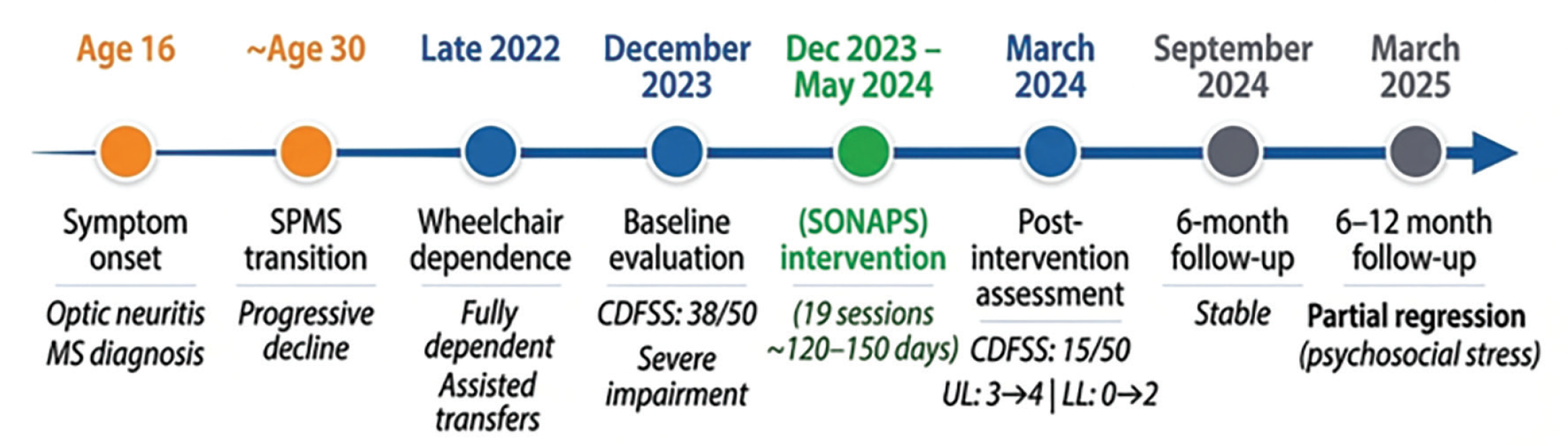
SONAPS: Somatic-neuropsychological adaptive programming system, CDFSS: Composite Disability and Functional Status Scale
Written informed consent was obtained from the patient for the publication of this case report, including accompanying clinical images and videos.
Baseline Symptoms
• Severe lower-limb weakness and spasticity
• Upper-limb tremor
• Neuropathic pain
• Urinary dysfunction
• Severe insomnia
• Cognitive fatigue and anxiety
Neurological Examination
• Lower-limb strength: 0/5 bilaterally
• Upper-limb strength: 3/5
• Positive bilateral Babinski signs
• Impaired trunk control and balance
Baseline Disability
Composite Disability and Functional Status Scale (CDFSS) score: 38/50
SONAPS Intervention
The patient completed 19 sessions (approximately 120 minutes each) over a period of 90-110 days.
SONAPS is a structured, non-invasive, and device-free intervention that operates within an adaptive closed-loop clinical framework integrating PSF and PBC domains. The intervention content is dynamically adjusted according to patient responses during structured tasks.
The intervention was entirely device-free and consisted of structured, task-oriented sensorimotor and behavioral components.
Core elements included guided postural adjustments, coordination-focused motor tasks, graded muscle activation, and real-time therapist feedback based on observed patient responses.
No external devices, electrical stimulation, or pharmacological modifications were used during the intervention period.
Session Structure
Each session included the following components:
• Interval symptom review
• Structured assessment using PSF and PBC anchors
• Individualized multimodal intervention targeting:
• Postural control
• Sensorimotor integration
• Coordination
• Fatigue modulation
• Behavioral and emotional regulation
• Adaptive task sequencing
• Post-session reassessment
Although individualized, all sessions followed a consistent structural framework to support conceptual reproducibility.
Outcome Measures
Primary Outcome
CDFSS
Secondary Outcomes
Muscle strength (Medical Research Council MRC scale)
Patient-reported symptom severity (0-10 scale)
Results
Composite disability improved from 38/50 to 15/50, representing an approximately 61% reduction ().
Table 1. Prespecified outcomes before and after the SONAPS intervention
Domain | Measure | Baseline | Post |
|---|---|---|---|
Disability | CDFSS | 38 | 15 |
Strength | MRC upper limb | 3 | 4 |
- | MRC lower limb | 0 | 2 |
PSF | Spasticity (0-10) | 10 | 6 |
- | Tremor (0-10) | 10 | 4 |
Balance limitation (0-10) | 10 | 6 | |
Neuropathic pain (0-10) | 9 | 5 | |
PBC | Anxiety (0-10) | 9 | 5 |
- | Depression (0-10) | 8 | 5 |
Cognition | Brain fog (0-10) | 10 | 4 |
CDFSS: Composite Disability and Functional Status Scale, MRC: Medical Research Council Scale, PSF: Physical-structural-functional, PBC: Psychological-behavioral-cognitive
Subscale Changes
Physical: 19 → 8
Cognitive/psychological: 11 → 1
Functional: 8 → 6
Muscle Strength
Upper limbs: 3 → 4
Lower limbs: 0 → 2
Functional Changes
Improved assisted sit-to-stand ability
Improved trunk stability
Improved fine motor control
Representative images of the patient’s functional status before and after the intervention are presented in and .
Changes in symptom severity and CDFSS subscale scores are presented in and . No adverse events were observed.
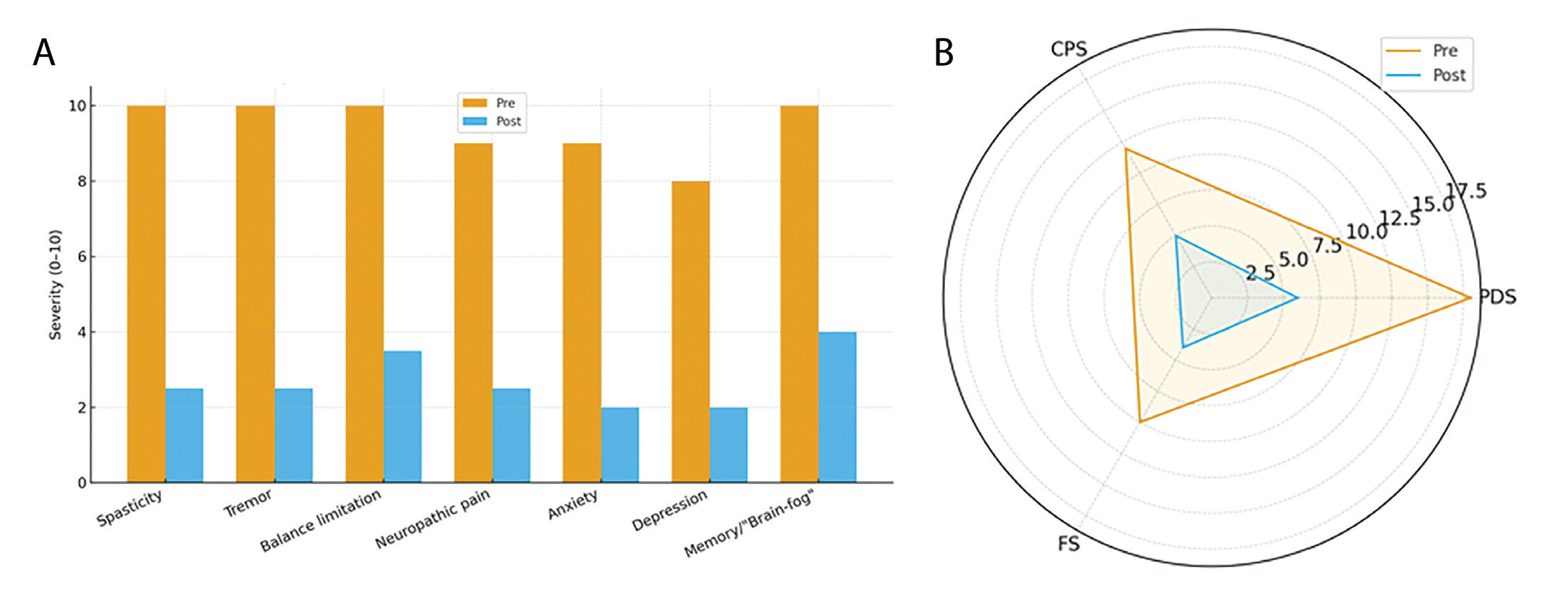
PSF: Physical-structural-functional, PBC: Psychological-behavioral-cognitive, CDFSS: Composite Disability and Functional Status Scale
Follow-up
At 6 months: Clinical status remained stable.
Between 6 and 12 months: Partial regression was observed during periods of psychosocial stress.
All outcomes should be interpreted as exploratory given the absence of validated measurement instruments.
Discussion
Functional improvement in advanced SPMS is uncommon due to progressive neurodegenerative mechanisms and limited recovery potential (, ).
In this case, multidomain improvement was observed; however, causal inference cannot be established. Alternative explanations—including behavioral engagement, expectancy effects, and measurement bias—should also be considered.
The absence of standardized outcome measures [e.g., Expanded Disability Status Scale (EDSS), Timed 25-Foot Walk (T25FW), and Nine-Hole Peg Test (9HPT), baseline magnetic resonance imaging (MRI) data, and validated assessment tools further limits interpretability ().
Neurobiological constraints related to aging and neuroplasticity may also limit recovery potential (). Mechanistic interpretations remain speculative and require validation using objective neurophysiological methods, such as electroencephalography- or magnetoencephalography-based connectivity analyses (, ).
Observed functional improvements were limited to assisted postural transitions and trunk control and did not include independent ambulation.
Study Limitations
Single-case, non-blinded design.
Absence of standardized outcome measures (EDSS, T25FW, 9HPT, and cognitive batteries).
No baseline MRI assessment.
Use of a non-validated CDFSS.
Reliance on subjective symptom ratings.
Conclusion
Multidomain functional improvement was observed in this case of advanced SPMS following a device-free intervention. These findings are exploratory in nature and require confirmation in controlled, blinded studies.
Footnotes
Ethics
Informed Consent: Written informed consent was obtained from the patient and participating family members for the publication of clinical information and video documentation.
Data Availability Statement
The clinical protocols and de-identified data supporting the findings of this case report are available from the corresponding author upon reasonable request. the SONAPS Clinic welcomes scientific inquiries and independent verification of the observed functional outcomes to support the development of structured non-pharmacological interventions in advanced MS.
Authorship Contributions
Surgical and Medical Practices: H.N., Concept: H.N., A.R., Design: H.N., Data Collection or Processing: H.N., Analysis or Interpretation: H.N., Literature Search: H.N., A.R., Writing: H.N., A.R.
Conflict of Interest: No conflict of interest was declared by the authors.
Financial Disclosure: The authors declared that this study received no financial support.
References
Lassmann H. Mechanisms of progressive multiple sclerosis. Brain. 2019;142:2522-2531.
Lublin FD, Reingold SC, Cohen JA, Cutter GR, Sørensen PS, Thompson AJ, Wolinsky JS, Balcer LJ, Banwell B, Barkhof F, Bebo B Jr, Calabresi PA, Clanet M, Comi G, Fox RJ, Freedman MS, Goodman AD, Inglese M, Kappos L, Kieseier BC, Lincoln JA, Lubetzki C, Miller AE, Montalban X, O’Connor PW, Petkau J, Pozzilli C, Rudick RA, Sormani MP, Stüve O, Waubant E, Polman CH. Defining the clinical course of multiple sclerosis: the 2013 revisions. Neurology. 2014;83:278-286.
Kremenchutzky M, Rice GP, Baskerville J, Wingerchuk DM, Ebers GC. The natural history of multiple sclerosis: a geographically based study 9: observations on the progressive phase of the disease. Brain. 2006;129:584-594.
Motl RW, Sandroff BM. Benefits of exercise training in multiple sclerosis. Curr Neurol Neurosci Rep. 2015;15:62.
Burke SN, Barnes CA. Neural plasticity in the ageing brain. Nat Rev Neurosci. 2006;7:30-40.
Chiarion G, Sparacino L, Antonacci Y, Faes L, Mesin L. Connectivity analysis in EEG data: a tutorial review of the state of the art and emerging trends. Bioengineering (Basel). 2023;10:372.
Brickwedde M, Anders P, Kühn AA, Lofredi R, Holtkamp M, Kaindl AM, Grent-’t-Jong T, Krüger P, Sander T, Uhlhaas PJ. Applications of OPM-MEG for translational neuroscience: a perspective. Transl Psychiatry. 2024;14:341.
Supplementary Materials
Supplementary Figures 1
Download