
Abstract
Multiple sclerosis (MS) is an immune-mediated disease characterized by inflammatory demyelinating lesions within the central nervous system. Bruton’s tyrosine kinase inhibitors (BTKis) modulate immune responses by inhibiting a key enzyme involved in B-cell receptor signaling and the activation of other immune cells. However, the efficacy and safety of BTKi remain controversial, and more comprehensive studies are required. We searched PubMed, Scopus, and the Cochrane Library for randomized controlled trials (RCTs) evaluating BTKis for MS through October 1, 2024, and identified six RCTs. A total of 2,960 patients from these trials were included to examine the efficacy and safety of BTKi in MS treatment. The included BTKi were evobrutinib [25,45, and 75 mg once daily; 75 mg twice daily (BID)], fenebrutinib (200 mg BID), and tolebrutinib. Across the included studies, evobrutinib—particularly at 75 mg BID—reduced the number of new T1 gadolinium-enhancing lesions and T2 lesion burden compared with placebo, with a favorable safety profile. In addition, its long-term efficacy was supported by stable outcomes and sustained safety. Other BTKi demonstrated promising short-term results; however, no long-term data are currently available. In contrast, none of the treatments showed significant changes in Expanded Disability Status Scale scores. Overall, BTKi have shown promising results in the treatment of MS. In particular, evobrutinib may serve as a suitable oral alternative for patients with mild to moderate disease due to its safety and selectivity. Nevertheless, further clinical trials are needed to better evaluate other BTKi and to provide a more comprehensive understanding of their long-term efficacy and safety.
Keywords: Systematic review, multiple sclerosis, BTKi, T1- and T2-weighted magnetic resonance imaging, randomized controlled trials, EDSS
Introduction
Multiple sclerosis (MS) is an autoimmune disorder characterized by the presence of plaques in the white and gray matter of the brain and spinal cord, caused by a chronic inflammatory process involving the central nervous system (CNS) (), in which axons are demyelinated during the body’s attack on its own axonal coverings, called myelin sheaths (, ). This process results in a complex array of symptoms, including numbness and tingling, vision impairment, focal weakness, bladder and bowel dysfunction, and cognitive impairment, which accounted for 512,985 disability-adjusted life years and 4,738 deaths worldwide in 2021 (). This represents a substantial burden on global productivity, as younger age groups had a considerable share of new-onset cases, primarily affecting individuals aged 20-44 years (, ), while patients under the age of 18 were also significantly impacted, with 30,000 cases reported in 2020 ().
The diagnosis of MS is primarily clinical, relying on patient history and physical examination findings. As no single laboratory test is diagnostic for MS, investigations such as magnetic resonance imaging (MRI) of the brain and spinal cord are used to support the diagnosis and monitor disease progression (, ).
Although B-cells and plasma cells contribute to the demyelination process, the protective functions of local microglial cells and derived macrophages, which aid in remyelination, appear to be impaired due to the proinflammatory environment observed in MS and other neurodegenerative diseases (). While current treatments have proven efficacy in preventing relapses and acute inflammatory episodes in active MS, no therapeutic option guarantees the prevention of disability accumulation associated with progressive MS, nor the regeneration of damaged neural components (). Accordingly, MS remains an incurable disease ().
Bruton tyrosine kinase inhibitors (BTKis) are a class of drugs that inhibit BTK, expressed on hematopoietic cells, primarily B lymphocytes, and play a key role in their differentiation, activation, signaling pathways, and overall function (, ). Research has shown that BTK expression on microglial cells in the brain is upregulated in patients with MS, contributing to the chronic inflammation observed in the disease (). BTK inhibitors can penetrate the CNS, thereby modulating both innate and adaptive immune systems involved in MS pathogenesis (, ). Additionally, they have demonstrated the ability to promote axonal remyelination by enhancing microglial clearance of myelin debris (), making them promising candidates for the treatment of MS.
Currently available oral treatments for MS, such as teriflunomide, dimethyl fumarate (DMF), and fingolimod, lack selectivity (teriflunomide is moderately selective), which results in multiple systemic side effects (). In contrast, evobrutinib is highly selective, suggesting fewer systemic side effects. Its dual action on adaptive and innate immunity, combined with improved selectivity, positions it as a promising therapeutic candidate that may address some of the unmet needs in MS management.
Methods
The procedure of our systematic review was conducted in accordance with the Preferred Reporting Items for Systematic Reviews and Meta-analyses guidelines ().
Research Strategy
A systematic literature search was independently conducted by three authors up to October 1, 2024. Databases searched included PubMed, Scopus, and the Cochrane Library, using a research strategy encompassing all known forms of BTK inhibitors and synonyms for MS. In addition, we manually screened the reference lists of relevant articles to ensure comprehensive inclusion of pertinent studies. Furthermore, we manually screened neurology.org.
(“BTK Inhibitor” OR “tolebrutinib” OR “evobrutinib” OR “Ibrutinib” OR “Pirtobrutinib” OR “Orelabrutinib” OR “Tirabrutinib” OR “Fenebrutinib” OR “Bruton’s tyrosine Inhibitor”) AND (“Multiple Sclerosis” OR “MS” OR “Disseminated Sclerosis” OR “Cerebrospinal Sclerosis” OR “Autoimmune Demyelinating Disorder” OR “Encephalomyelitis Disseminata”).
Eligibility Criteria
Inclusion criteria were determined using the PICO framework as follows: (1) population: participants diagnosed with MS, aged 18 years or older (up to 55 or 65 years); (2) intervention: administration of at least one class of oral BTKi for the treatment of any MS subtype, with comparisons made between various dosages and formulations of BTKi and placebo drugs; (3) outcomes: assessed using objective measures, specifically the Expanded Disability Status Scale (EDSS) and T1- and T2-weighted MRI; (4) exclusion criteria (1) absence of essential data, (2) studies presented solely as commentaries, book chapters, or animal studies, (3) studies with overlapping datasets, or (4) studies conducted solely in vitro.
Data Extraction and Quality Assessment
Data extraction was independently performed by two authors, with disagreements resolved by a third author. Fundamental study characteristics were meticulously collected, including authors, national clinical trial numbers, publication type, intervention type, study objectives, control groups, treatment groups, total participant numbers, study duration, and outcome events. Patient demographics, including gender and age, were also recorded. Additionally, inclusion and exclusion criteria, outcome assessments, and study conclusions were compiled. Study quality was assessed using the risk of bias tool to provide a comprehensive understanding of the included studies.
Outcomes
Primary outcomes included the number of new gadolinium-enhancing (Gd) T1 lesions, changes in T2 lesion volume (or number of new/enlarging T2 lesions where reported), and EDSS scores. Safety outcomes included treatment-emergent adverse events (TEAEs), categorized as grade 1 (asymptomatic), grade 2 (discomfort), grade 3 (severe), and grade 4 (life-threatening).
Results
Search Results
The literature search identified a total of 675 studies from PubMed, Scopus, and Cochrane using a preformatted search strategy. Using EndNote, 180 studies were duplicates, and 482 were excluded based on titles and abstracts. Fifty-five studies underwent full-text review, and six met the inclusion criteria; all were included in the systematic review ().
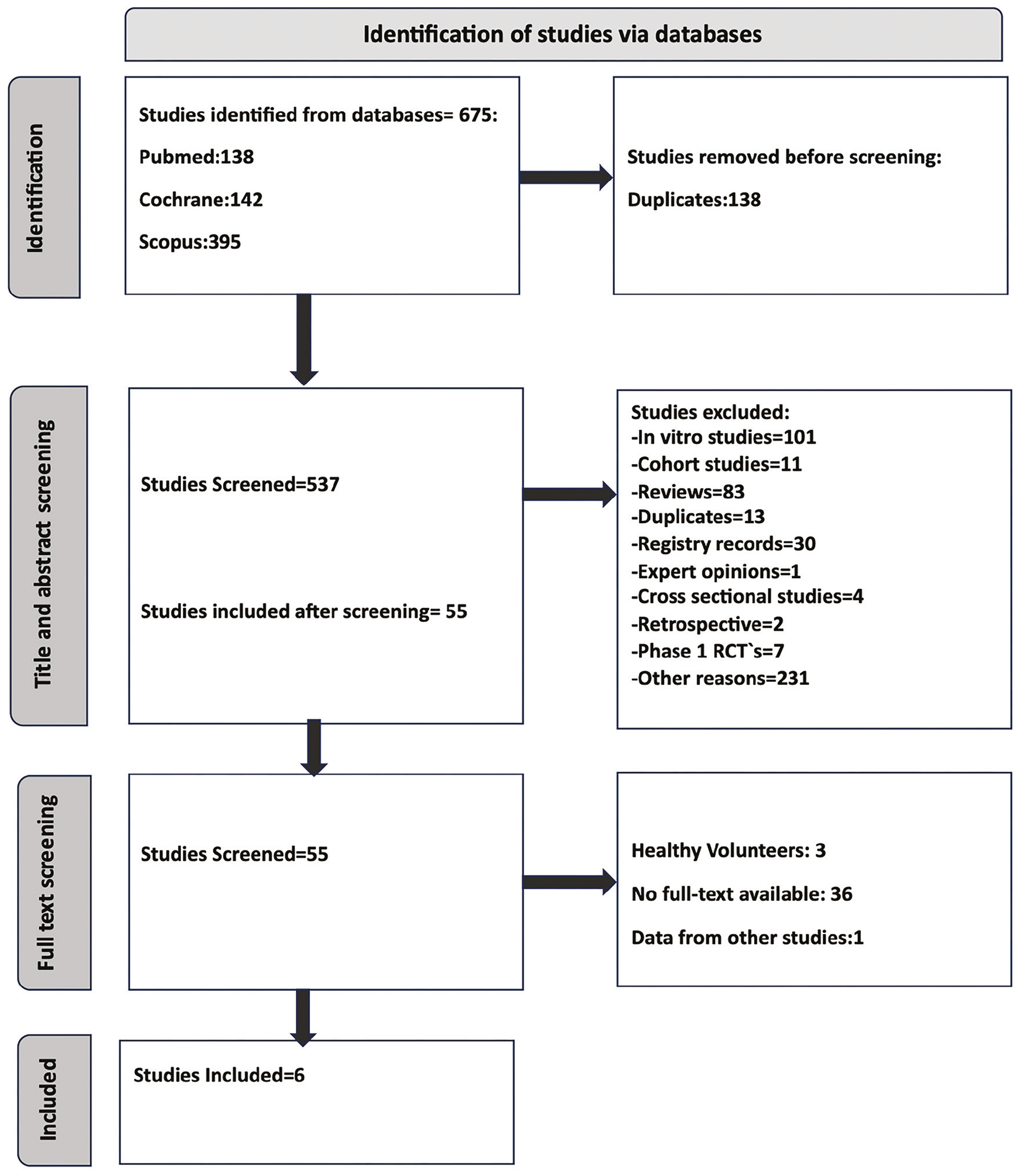
RCT: Randomized controlled trials
Study Characteristics
All six included studies were multicenter trials, including a total of 2,960 patients. Three studies were placebo-controlled (-), two were active-controlled (), and one was an open-label extension (OLE) (). Study periods ranged from 12 (16) to 192 weeks (). Mean ages were approximately 38.5 years, with EDSS scores below 6, including both relapsing-remitting MS (RRMS) and secondary progressive MS, with RRMS being the majority. Sample sizes varied substantially among the studies, ranging from 109 (16) to 1,166 participants ().
Two studies compared evobrutinib with teriflunomide (), one study compared evobrutinib with placebo (), one study compared fenebrutinib with placebo (), and one study compared tolebrutinib with placebo (). Doses ranged from evobrutinib 25 mg once daily (QD) to fenebrutinib 200 mg twice daily (BID).
Risk of Bias
Three of the six trials showed low risk of bias across all five domains (-). One study showed high risk of randomization bias due to the lack of randomization, as it was an OLE trial (). The evolutionRMS 1 and 2 studies raised concerns due to high withdrawal rates (approximately 20%), increasing the risk of missing outcome data () ().
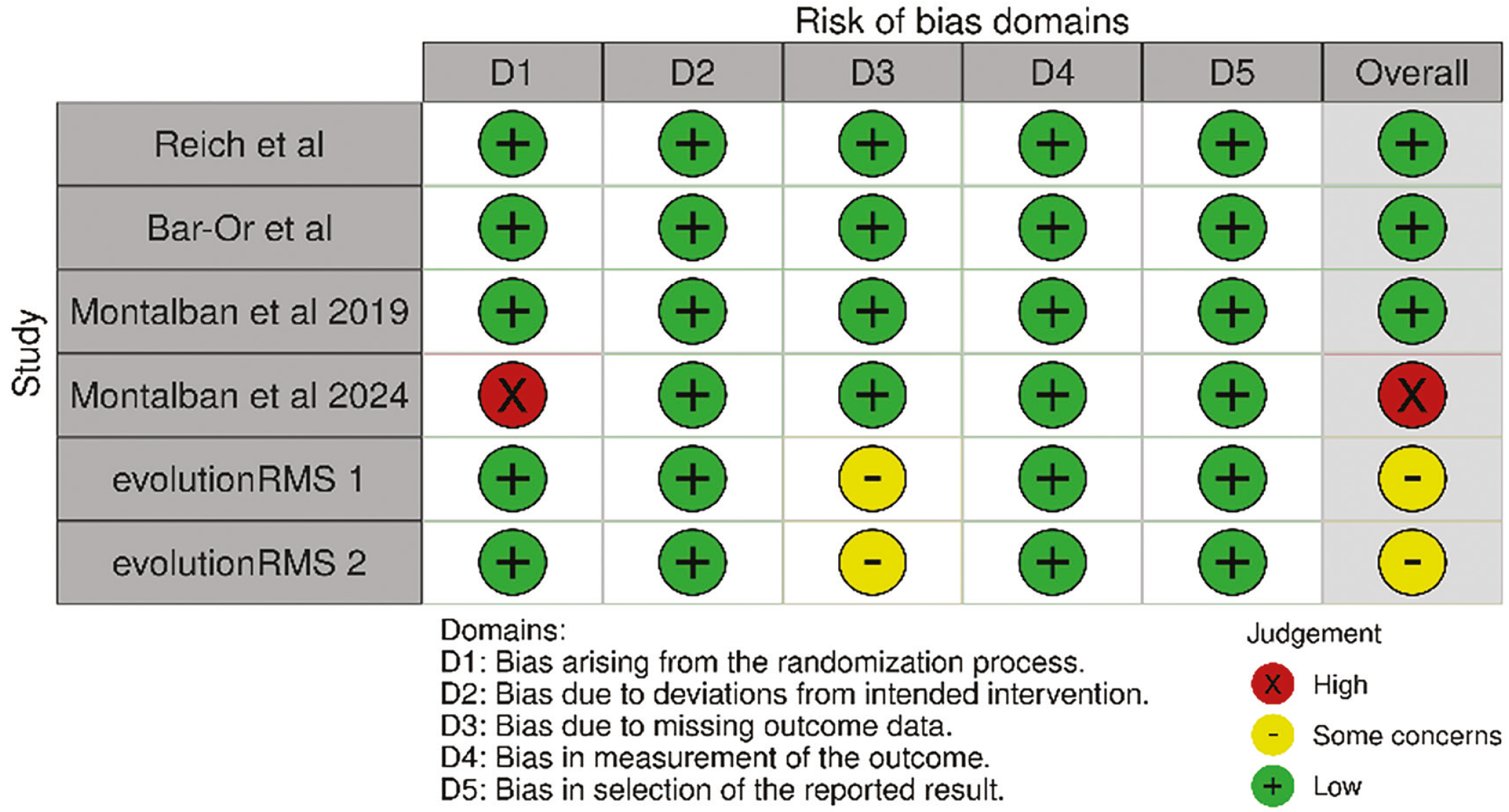
RMS: Relapsing multiple sclerosis
Efficacy
- Number of New T1 Gd+ Lesions
All included studies assessed the number of new T1 Gd+ lesions. One study compared evobrutinib (25 mg QD, 75 mg QD, and 75 mg BID), placebo, and DMF (). Patients in the evobrutinib 75 mg BID group showed a rapid onset of action and a marked reduction in the mean number of new T1 Gd+ lesions during the first 12 weeks. Patients in the evobrutinib 75 mg QD group showed a significantly lower number of new T1 Gd+ lesions from week 12 to week 24, but not at other doses.
Two studies compared evobrutinib (45 mg BID) with teriflunomide (14 mg QD). Both studies indicated similar improvements in the first 24 weeks for both drugs, but lesion numbers increased with evobrutinib, unlike teriflunomide, after week 24 ().
An OLE (75 mg QD and 75 mg BID) showed that the mean number of T1 Gd+ lesions changed according to dose. There was a temporary increase with evobrutinib 75 mg QD, followed by a decrease after switching to 75 mg BID in the OLE ().
One study compared tolebrutinib (5,15,30, and 60 mg) with placebo. The maximal effect was observed at 60 mg, where 90% of participants had no new Gd-enhancing lesions ().
A study comparing fenebrutinib 200 mg BID with placebo showed a 69% reduction in total new T1 Gd+ lesions at weeks 4, 8, and 12 combined, with a rapid reduction of 49% by Week 4, 92% by Week 8, and 90% by Week 12 ().
- T2 Lesion Volume
All six studies assessed changes in T2 lesion volume. One study comparing evobrutinib (25 mg QD, 75 mg QD, and 75 mg BID) with placebo reported a T2 lesion volume of 0.42 at week 24 in the 75 mg BID group, indicating better response than other doses (). Two studies comparing evobrutinib (45 mg BID) with teriflunomide (14 mg QD) showed that evobrutinib was not superior to teriflunomide (). In the OLE (75 mg QD followed by 75 mg BID), T2 lesion volumes remained stable from baseline to week 192 across the double-blind treatment groups ().
A study comparing fenebrutinib with placebo demonstrated relative reductions of 90% and 95% in T2 lesions at weeks 8 and 12, respectively ().
Another study comparing tolebrutinib with placebo suggested a dose-dependent linear relationship with new or enlarging T2 lesions, significant across all six dose-response models ().
- EDSS Score
Two studies assessed changes in EDSS scores (, ). One study showed no significant change from baseline in patients receiving evobrutinib (25 mg QD, 75 mg QD, and 75 mg BID) (). In the OLE, patients switched from 75 mg QD to BID after a mean duration of 50.6 weeks (±6.0), and EDSS scores remained stable, with no change in median baseline EDSS throughout the study, regardless of the initial treatment arm. This may reflect that EDSS is less sensitive to changes over a one-year period compared to Gd+ lesions ().
Safety
One study comparing evobrutinib (25 mg QD, 75 mg QD, and 75 mg BID) with placebo and DMF reported the highest rate of serious adverse events (7%) in patients treated with evobrutinib 75 mg BID. The most common evobrutinib-related adverse events were nasopharyngitis and increased levels of alanine aminotransferase, aspartate aminotransferase, and lipase. Evobrutinib also had lower rates of systemic adverse events, such as flushing, compared with DMF ().
In the OLE, no new safety signals were identified with long-term evobrutinib treatment. TEAEs were mild to moderate, including nasopharyngitis (15%) and increased lipase (12%). No serious elevations in liver aminotransferases were observed during the double-blind period ().
Two studies comparing evobrutinib (45 mg BID) with teriflunomide (14 mg QD) indicated a clinically relevant risk of drug-induced liver injury, limiting use in patients with pre-existing liver conditions ().
One study comparing fenebrutinib with placebo reported no new safety concerns, consistent with earlier findings, suggesting a favorable benefit-risk profile ().
Overall, BTK inhibitors rarely cause adverse events, with systemic adverse events being particularly uncommon. provides further details.
Table 1. Studies key findings
Study ID | Design | Intervention | Dosing arms & frequency | Key findings |
|---|---|---|---|---|
Reich et al. () | Phase 2b RCT | Tolebrutinib | (5,15,30,60) mg once daily | The study demonstrated a dose-dependent reduction in new gadolinium-enhancing (Gd) lesions, with the 60 mg dose achieving an 85% reduction (p=0.03) and an 89% reduction in new or enlarging T2 lesions (p<0.0001). Higher tolebrutinib exposure correlated with fewer new lesions, and taking the drug with food significantly increased plasma concentration. Exploratory imaging showed a reduction in slowly evolving lesions at 60 mg, suggesting potential effects on chronic inflammation, while paramagnetic rim lesions were found in 50% of participants, indicating persistent neuroinflammation. Tolebrutinib was well tolerated, with headache (7%) as the most common adverse event and one serious adverse event (MS relapse in the 60 mg group), which did not lead to treatment discontinuation. Mild ALT elevations were seen in two patients but resolved without stopping treatment. These findings support the continued development of tolebrutinib in phase 3 trials for relapsing and progressive multiple sclerosis. |
Bar-Or et al. () | Phase 2 RCT | Fenebrutinib | 200 mg twice daily | Fenebrutinib demonstrated a 69% reduction in the total number of new T1 Gd+ lesions over 12 weeks, with a rapid onset of efficacy observed by week 4. At weeks 8 and 12, lesion reductions reached 92% and 90% for T1 Gd+ lesions, and 90% and 95% for T2-weighted lesions, respectively. Exploratory analyses showed that fenebrutinib penetrated the cerebrospinal fluid (CSF) at levels sufficient to inhibit B-cell and microglia activation, suggesting potential effects on chronic inflammation and progressive disease mechanisms. The treatment was well tolerated, with no serious adverse events reported. Most adverse events were mild or moderate (Grade 1 or 2), except for two Grade 3 asymptomatic liver transaminase elevations. These findings highlight fenebrutinib’s early and significant anti-inflammatory effects in relapsing multiple sclerosis, supporting its further clinical development. |
Montalban et al. () 2019 | Phase 2 RCT | Evobrutinib | 25 mg once, 75 mg once, 75 mg twice daily | Evobrutinib significantly reduced the total number of Gd+ lesions on T1-weighted MRI at weeks 12 through 24, with the 75 mg once-daily dose showing the greatest effect (rate ratio: 0.30, p=0.005) compared to placebo. However, the 25 mg once-daily and 75 mg twice-daily doses did not show a statistically significant difference. There was no significant reduction in the annualized relapse rate (ARR) or disability progression at any dose level. The treatment was generally well tolerated, but higher doses (75 mg once or twice daily) were associated with an increased incidence of liver enzyme elevations (ALT, AST) and lipase. While most patients remained relapse-free, the safety profile and need for hepatic monitoring warrant further investigation. These findings support further evaluation of evobrutinib in larger, longer trials to determine its role in multiple sclerosis management. |
Montalban et al. () 2024 | Phase 2 RCT | Evobrutinib | 25 mg once, 75 mg once, 75 mg twice daily | Evobrutinib demonstrated a sustained reduction in disease activity over more than 3.5 years, with a stable ARR of 0.11 and consistently low T1 Gd+ lesion counts. A rapid onset of efficacy was observed within the first 12 weeks, with significant reductions in new T1 Gd+ lesions and a decrease in neurofilament light chain (NfL) levels, a biomarker of neuroaxonal damage. Evobrutinib effectively penetrated the CSF at concentrations sufficient to achieve high Bruton’s tyrosine kinase occupancy, indicating potential modulation of both peripheral and central nervous system inflammation. The treatment was well tolerated, with no new safety signals identified, and most adverse events were mild or moderate. These findings support evobrutinib’s long-term efficacy and safety in relapsing multiple sclerosis, reinforcing its potential as a disease-modifying therapy. |
EvolutionRMS 1 | Phase 3 RCT | Evobrutinib or teriflunomide | 45 mg twice daily or 14 mg once daily | Evobrutinib did not demonstrate superiority over teriflunomide in reducing relapses, with an ARR of 0.15 vs. 0.14 (p=0.55). MRI results showed a higher number of new T1 Gd+ lesions in the evobrutinib group (0.50 vs. 0.35 per scan). There was no significant difference in 12-week and 24-week confirmed disability progression, and serum NfL levels remained comparable between the groups. However, higher liver enzyme elevations were observed in patients receiving evobrutinib, with 5% experiencing ALT increases above 5× the upper limit of normal, compared to less than 1% in the teriflunomide group. These findings suggest that evobrutinib does not offer a significant advantage over teriflunomide for managing RMS. |
EvolutionRMS 2 | Phase 3 RCT | Evobrutinib or teriflunomide | 45 mg twice daily or 14 mg once daily | Evobrutinib showed no significant difference in the efficacy compared to teriflunomide, with both groups having an identical ARR of 0.11 (p=0.51). Evobrutinib was associated with a higher number of new T1 Gd+ lesions (0.50 vs. 0.31 per scan), indicating no added benefit in suppressing acute inflammation. Disability progression rates and neuroaxonal damage markers (NfL levels) remained similar between both treatments, further confirming the lack of superiority. The safety profile mirrored that of evolutionRMS 1, with higher rates of liver enzyme elevations observed in the evobrutinib group. Overall, these results reinforce that evobrutinib does not provide additional efficacy benefits over teriflunomide in treating relapsing multiple sclerosis. |
RMS: Relapsing multiple sclerosis, RCT: Randomized controlled trial, ALT: Alanine aminotransferase, AST: Aspartate aminotransferase, MRI: Magnetic resonance imaging
Discussion
This systematic review synthesizes current evidence on BTKi for the treatment of MS and discusses their efficacy and safety. The findings suggest that BTKi represent a promising class of oral drugs for mild and moderate cases.
A systematic review of BTKi in MS is important as it consolidates all available evidence to establish their efficacy in reducing radiological disease activity, such as new lesions, and clarifies their distinct safety profile, particularly the risk of liver enzyme elevations. This provides clinicians and researchers with a critical, evidence-based foundation for evaluating this emerging therapeutic class.
The studies indicate that BTKi produce a positive and rapid improvement in MRI findings, particularly at the evobrutinib 75 mg BID dose. DMF is an oral DMT with moderate efficacy and a favorable safety profile (), but current trials suggest that evobrutinib shows superior outcomes, especially in the short term (). Evobrutinib 75 mg BID demonstrated an 83% reduction in new T1 Gd+ lesions, compared with 75% with DMF during the first 24 weeks of treatment (), suggesting its potential as an alternative oral therapy for MS.
However, evobrutinib showed stable T2 lesion volume across treatment groups, with only slight reductions at the 75 mg BID dose for both short- and long-term use (), similar to DMF (). Likewise, EDSS scores showed little to no change in both treatments ().
Evobrutinib’s high selectivity reduces systemic side effects (). This is noteworthy because flushing is a common adverse effect of DMF—22% of patients receiving 120 mg twice daily for the first week, followed by 240 mg twice daily thereafter, experience flushing (). Therefore, evobrutinib may be a suitable alternative in patients experiencing severe flushing.
Phase 3 studies comparing evobrutinib 45 mg BID with teriflunomide 14 mg QD were less promising (), likely due to the relatively low dose, as long-term effects of evobrutinib 75 mg BID were markedly better than 75 mg QD ().
Trials of other BTKi, such as tolebrutinib and fenebrutinib, were too short to provide strong evidence of their efficacy. Nevertheless, these trials demonstrated some promising results, highlighting the importance of advancing these agents to phase 3 trials.
Study Limitations
This systematic review has several limitations. Variations among included studies in terms of study duration, BTKi type, and dosing prevented a meta-analysis across all studies. Furthermore, additional studies on other BTKi formulations are needed to provide a comprehensive understanding of their efficacy and safety. Future research should focus on comparing the long-term efficacy of high-dose evobrutinib (75 mg BID) with other oral MS therapies, such as DMF and teriflunomide, in mild and moderate cases. Advancing trials for other BTKi and for evobrutinib 75 mg BID to phase 3 will provide more definitive evidence to guide clinical use.
Conclusion
Evidence from randomized trials confirms that BTK inhibitors provide a potent and rapid reduction in gadolinium-enhancing lesions in MS, highlighting their strong effect on suppressing inflammatory activity. The therapeutic effect is dose-dependent but may not be sustained across all dosing regimens. BTKi are generally well tolerated, with hepatic events being the most notable safety concern. Long-term stability of EDSS scores suggests the need for further investigation into their effects on disability progression. These findings support BTKi as a valuable addition to the MS treatment arsenal, with dose optimization and liver safety as key considerations for clinical use.
Footnotes
Acknowledgement
The authors thank Ramez Odat and Anas Zakarya for their assistance and support during this project.
Authorship Contributions
Concept: H.I.M., M.N.B., A.S.A., Design: H.I.M., M.N.B., A.A.A.R., A.N.A., Data Collection or Processing: H.I.M., A.A.A.R., A.S.A., A.N.A., Analysis or Interpretation: H.I.M., Literature Search: H.I.M., M.N.B., A.I.A., A.S.A., B.N.B., Writing: H.I.M., M.N.B., A.I.A., A.S.A., A.N.A., B.N.B.
Conflict of Interest: No conflict of interest was declared by the authors.
Financial Disclosure: The authors declared that this study received no financial support.
References
Dighriri IM, Aldalbahi AA, Albeladi F, Tahiri AA, Kinani EM, Almohsen RA, Alamoudi NH, Alanazi AA, Alkhamshi SJ, Althomali NA, Alrubaiei SN, Altowairqi FK. An overview of the history, pathophysiology, and pharmacological interventions of multiple sclerosis. Cureus. 2023;15:e33242.
Broos JY, van der Burgt RTM, Konings J, Rijnsburger M, Werz O, de Vries HE, Giera M, Kooij G. Arachidonic acid-derived lipid mediators in multiple sclerosis pathogenesis: fueling or dampening disease progression? J Neuroinflammation. 2024;21:21.
Kister A, Kister I. Overview of myelin, major myelin lipids, and myelin-associated proteins. Front Chem. 2023;10:1041961.
Wang LY, Wang WF, Hui SY, Yang L, Liu YX, Li HJ. Emerging epidemiological trends of multiple sclerosis among adults aged 20-54 years, 1990-2021, with projections to 2035: a systematic analysis for the global burden of disease study 2021. Front Neurol. 2025;16:1616245.
Qian Z, Li Y, Guan Z, Guo P, Zheng K, Du Y, Yin S, Chen B, Wang H, Jiang J, Qiu K, Zhang M. Global, regional, and national burden of multiple sclerosis from 1990 to 2019: findings of global burden of disease study 2019. Front Public Health. 2023;11:1073278.
Walton C, King R, Rechtman L, Kaye W, Leray E, Marrie RA, Robertson N, La Rocca N, Uitdehaag B, van der Mei I, Wallin M, Helme A, Angood Napier C, Rijke N, Baneke P. Rising prevalence of multiple sclerosis worldwide: insights from the Atlas of MS, third edition. Mult Scler. 2020;26:1816-1821.
Hemond CC, Bakshi R. Magnetic resonance imaging in multiple sclerosis. Cold Spring Harb Perspect Med. 2018;8:a028969.
Ford H. Clinical presentation and diagnosis of multiple sclerosis. Clin Med (Lond). 2020;20:380-383.
Zindler E, Zipp F. Neuronal injury in chronic CNS inflammation. Best Pract Res Clin Anaesthesiol. 2010;24:551-562.
Smith JA, Nicaise AM, Ionescu RB, Hamel R, Peruzzotti-Jametti L, Pluchino S. Stem cell therapies for progressive multiple sclerosis. Front Cell Dev Biol. 2021;9:696434.
Rozkiewicz D, Hermanowicz JM, Kwiatkowska I, Krupa A, Pawlak D. Bruton’s tyrosine kinase inhibitors (BTKIs): review of preclinical studies and evaluation of clinical trials. Molecules. 2023;28:2400.
Ringheim GE, Wampole M, Oberoi K. Bruton’s tyrosine kinase (BTK) inhibitors and autoimmune diseases: making sense of BTK inhibitor specificity profiles and recent clinical trial successes and failures. Front Immunol. 2021;12:662223.
Geladaris A, Torke S, Saberi D, Alankus YB, Streit F, Zechel S, Stadelmann-Nessler C, Fischer A, Boschert U, Häusler D, Weber MS. BTK inhibition limits microglia-perpetuated CNS inflammation and promotes myelin repair. Acta Neuropathol. 2024;147:75.
Kalincik T, Kubala Havrdova E, Horakova D, Izquierdo G, Prat A, Girard M, Duquette P, Grammond P, Onofrj M, Lugaresi A, Ozakbas S, Kappos L, Kuhle J, Terzi M, Lechner-Scott J, Boz C, Grand’Maison F, Prevost J, Sola P, Ferraro D, Granella F, Trojano M, Bergamaschi R, Pucci E, Turkoglu R, McCombe PA, Pesch VV, Van Wijmeersch B, Solaro C, Ramo-Tello C, Slee M, Alroughani R, Yamout B, Shaygannejad V, Spitaleri D, Sánchez-Menoyo JL, Ampapa R, Hodgkinson S, Karabudak R, Butler E, Vucic S, Jokubaitis V, Spelman T, Butzkueven H. Comparison of fingolimod, dimethyl fumarate and teriflunomide for multiple sclerosis. J Neurol Neurosurg Psychiatry. 2019;90:458-468.
Page MJ, McKenzie JE, Bossuyt PM, Boutron I, Hoffmann TC, Mulrow CD, Shamseer L, Tetzlaff JM, Akl EA, Brennan SE, Chou R, Glanville J, Grimshaw JM, Hróbjartsson A, Lalu MM, Li T, Loder EW, Mayo-Wilson E, McDonald S, McGuinness LA, Stewart LA, Thomas J, Tricco AC, Welch VA, Whiting P, Moher D. The PRISMA 2020 statement: an updated guideline for reporting systematic reviews. Rev Esp Cardiol (Engl Ed). 2021;74:790-799. English, Spanish. Erratum in: Rev Esp Cardiol (Engl Ed). 2022;75:192.
Bar-Or A, Dufek M, Budincevic H, Drulovic J, Habek M, Hua LH, Weber MS, Thomas P, Napieralski J, Clayton D, Kuruvilla D, Qi Q, Xu Y, Goodyear A, Oh J. Impact of fenebrutinib treatment on MRI outcomes and cerebrospinal fluid penetrance in multiple sclerosis: results from the phase II FENopta study (S31.004). Neurology. 2024;102(17 Suppl 1):S31.004.
Reich DS, Arnold DL, Vermersch P, Bar-Or A, Fox RJ, Matta A, Turner T, Wallström E, Zhang X, Mareš M, Khabirov FA, Traboulsee A; Tolebrutinib Phase 2b Study Group. Safety and efficacy of tolebrutinib, an oral brain-penetrant BTK inhibitor, in relapsing multiple sclerosis: a phase 2b, randomised, double-blind, placebo-controlled trial. Lancet Neurol. 2021;20:729-738.
Montalban X, Arnold DL, Weber MS, Staikov I, Piasecka-Stryczynska K, Willmer J, Martin EC, Dangond F, Syed S, Wolinsky JS; Evobrutinib Phase 2 Study Group. Placebo-controlled trial of an oral BTK inhibitor in multiple sclerosis. N Engl J Med. 2019;380:2406-2417.
Montalban X, Vermersch P, Arnold DL, Bar-Or A, Cree BAC, Cross AH, Kubala Havrdova E, Kappos L, Stuve O, Wiendl H, Wolinsky JS, Dahlke F, Le Bolay C, Shen Loo L, Gopalakrishnan S, Hyvert Y, Javor A, Guehring H, Tenenbaum N, Tomic D; evolutionRMS investigators. Safety and efficacy of evobrutinib in relapsing multiple sclerosis (evolutionRMS1 and evolutionRMS2): two multicentre, randomised, double-blind, active-controlled, phase 3 trials. Lancet Neurol. 2024;23:1119-1132.
Montalban X, Piasecka-Stryczynska K, Kuhle J, Benkert P, Arnold DL, Weber MS, Seitzinger A, Guehring H, Shaw J, Tomic D, Hyvert Y, Harlow DE, Dyroff M, Wolinsky JS. Efficacy and safety results after >3.5 years of treatment with the Bruton’s tyrosine kinase inhibitor evobrutinib in relapsing multiple sclerosis: long-term follow-up of a phase II randomised clinical trial with a cerebrospinal fluid sub-study. Mult Scler. 2024;30:558-570.
Thaler C, Faizy T, Sedlacik J, Holst B, Stellmann JP, Young KL, Heesen C, Fiehler J, Siemonsen S. T1- Thresholds in black holes increase clinical-radiological correlation in multiple sclerosis patients. PLoS One. 2015;10:e0144693.
Saida T, Yamamura T, Kondo T, Yun J, Yang M, Li J, Mahadavan L, Zhu B, Sheikh SI. A randomized placebo-controlled trial of delayed-release dimethyl fumarate in patients with relapsing-remitting multiple sclerosis from East Asia and other countries. BMC Neurol. 2019;19:5.